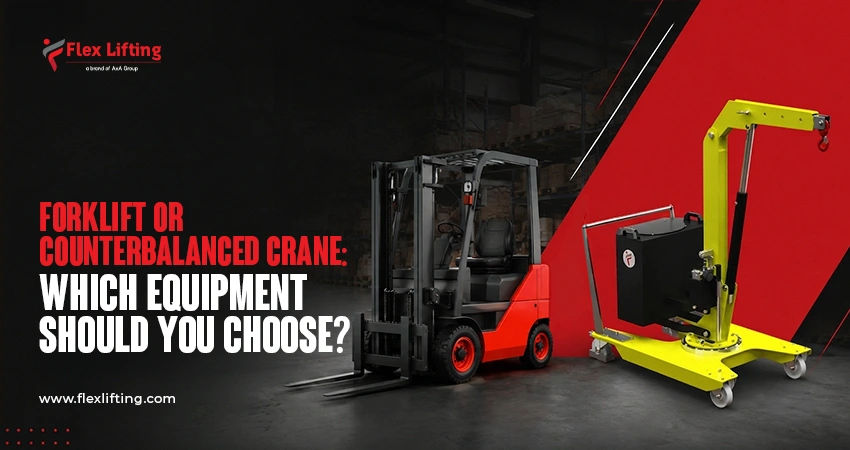
Forklifts and counterbalanced cranes are often compared because both can lift and handle loads.
In reality, however, they perform different operations.
A forklift is primarily designed to pick up, transport and stack materials, which are often placed on pallets. A counterbalanced crane, on the other hand, lifts the load using a hook or a suitable lifting attachment, allowing it to reach the load from above, keep it suspended and position it accurately.
The choice therefore does not depend on which machine is better overall, but on the type of load, the working environment and the operation to be performed.
Why the Comparison Can Be Misleading
A forklift and a counterbalanced crane are not two versions of the same machine.
A forklift normally supports the load from underneath using its forks. A crane, by contrast, lifts it from above using a hook, chain, vacuum lifter, clamp or another compatible attachment.
This difference becomes particularly important when:
- The forks cannot be inserted underneath the load;
- A component must be lowered into a machine;
- There are obstacles on the floor;
- The load must be reached from above;
- Accurate positioning is required;
- The installation point is located beyond the base of the machine.
A crane should therefore not be considered simply a more powerful replacement for a forklift. The two types of equipment are designed to meet different operational requirements.
When to Choose a Forklift
A forklift is one of the most commonly used material-handling machines in warehouses, manufacturing facilities, logistics centres and loading and unloading areas.
The forks are inserted underneath a pallet or a load designed to be lifted. The lifting system then raises the material, allowing the operator to transport it and place it in the required position.
The rear counterweight contributes to the stability of the machine. However, every operation must be carried out in accordance with the rated capacity, the position of the load’s centre of gravity and the load chart specified by the manufacturer.
A forklift is particularly suitable for:
- Picking up palletised goods;
- Loading and unloading trucks;
- Transporting materials within warehouses and manufacturing facilities;
- Stacking pallets and containers;
- Supplying production lines;
- Performing frequent and repetitive handling operations;
- Travelling relatively short distances with the load supported on the forks.
When a material can be supported from underneath and mainly needs to be transported, a forklift is generally the most efficient solution.
When to Choose a Counterbalanced Crane
A counterbalanced crane is designed to lift and position suspended loads.
Thanks to its lifting boom, it can reach a load from above and handle it even when access with forks is not possible. This makes it particularly useful for assembly, maintenance and installation work.
Compact mobile counterbalanced cranes can also be used inside production departments, workshops, warehouses and areas where space is limited.
A counterbalanced crane is particularly suitable for:
- Installing or removing motors and mechanical components;
- Positioning dies inside presses;
- Handling machine parts;
- Carrying out maintenance work;
- Lifting non-palletised components;
- Reaching over obstacles or structures located on the floor;
- Accessing the load from above;
- Positioning components in difficult-to-reach areas;
- Performing controlled movements that require precision.
Depending on the model, a counterbalanced crane may be equipped with a telescopic boom, radio remote control, powered rotation, electric travel and different lifting attachments.
The Advantage of Horizontal Reach
One of the most important differences concerns horizontal reach.
A forklift must normally approach the load and insert its forks underneath it. A counterbalanced crane can instead extend its boom beyond the base of the machine, reaching the lifting point even when an obstacle is present.
This feature is useful, for example, when it is necessary to:
- Remove a component from inside a machine;
- Position a load behind a barrier;
- Reach the upper part of a system;
- Install an element above a workbench;
- Operate without inserting forks underneath the material.
It is important to remember, however, that the lifting capacity of a crane generally decreases as its horizontal reach increases. Before every operation, the load chart of the specific model must therefore be checked.
Positioning Accuracy
A forklift is highly efficient for transporting and stacking materials, but it may be less suitable when a load must be inserted into a confined space or aligned very accurately.
A counterbalanced crane keeps the component suspended, making its positioning easier to control.
This feature is particularly useful for:
- Assembling machinery;
- Replacing components;
- Inserting dies;
- Positioning motors;
- Carrying out industrial maintenance;
- Installing delicate or valuable components.
The level of accuracy naturally depends on the model, the controls, the lifting attachment and the operator’s training and experience.
Forklifts and Suspended Loads
A forklift must not be improperly converted into a crane by attaching chains, ropes or hooks directly to its forks.
When it is necessary to lift a suspended load with a forklift, only compatible attachments that have been correctly installed and approved by the manufacturer should be used.
The use of an attachment changes the weight, centre of gravity and residual lifting capacity of the forklift.
For frequent suspended-load operations or work requiring a high level of load control, a crane specifically designed for this purpose is generally the more appropriate choice.
Forklift and Counterbalanced Crane Comparison
| Feature | Counterbalanced crane | Forklift |
|---|---|---|
| Load handling method | From above, using a hook or lifting attachment | From underneath, mainly using forks |
| Typical applications | Installation, maintenance, assembly and positioning | Logistics, warehousing, loading and unloading |
| Typical loads | Machinery, dies, motors and non-palletised components | Pallets, containers and materials designed for fork handling |
| Reaching over obstacles | Possible thanks to the boom’s horizontal reach | Generally limited by the need to approach the load with the forks |
| Precision | High during positioning operations | High during transport and stacking |
| Working environments | Workshops, production departments, maintenance areas and construction sites | Warehouses, factories, logistics areas and yards |
| Access to the load | From above or beyond an obstacle | Normally requires clearance underneath the load |
| Capacity | Depends on the model and decreases as the reach increases | Depends on the model, centre of gravity and lifting height |
How to Choose the Right Equipment
Before choosing between a forklift and a counterbalanced crane, it is useful to answer the following questions:
- Is the load palletised?
- Can the forks be inserted underneath the material?
- Does the load only need to be transported, or must it also be positioned?
- Does it need to be reached from above?
- Are there any obstacles between the machine and the placement point?
- What are the weight, dimensions and centre of gravity of the load?
- At what height and distance must it be positioned?
- Does the machine need to travel with the load?
- How much manoeuvring space is available?
- How frequently will the operation be performed?
When the main task is handling pallets, loading trucks or stacking goods, a forklift is generally the most suitable choice.
When the load must be lifted from above, kept suspended, moved beyond an obstacle or positioned accurately, a counterbalanced crane may offer a more suitable solution.
Safety During Lifting Operations
Regardless of the type of machine used, every operation must be properly planned and carried out by trained personnel.
Before lifting, it is necessary to verify:
- The actual weight of the load;
- The position of its centre of gravity;
- The residual lifting capacity of the machine;
- The load chart;
- The compatibility of the attachments;
- The stability of the surface;
- The available working space;
- The absence of people underneath or near the suspended load;
- The condition of the machine and lifting accessories.
Choosing unsuitable equipment or failing to follow the manufacturer’s instructions may compromise the stability of the machine and the safety of the entire operation.
Conclusion
Forklifts and counterbalanced cranes are not competing types of equipment. They are complementary solutions.
A forklift is ideal for transporting, lifting and stacking palletised materials. A counterbalanced crane is particularly suitable when a load must be picked up from above, kept suspended, moved over an obstacle or positioned accurately.
Flex Lifting designs and manufactures mobile counterbalanced cranes in Italy for industrial applications, maintenance work and lifting operations in confined spaces.
The range includes manual and electric models with different capacities, configurations and horizontal reach options, making it possible to identify the most suitable solution for every specific material-handling requirement.