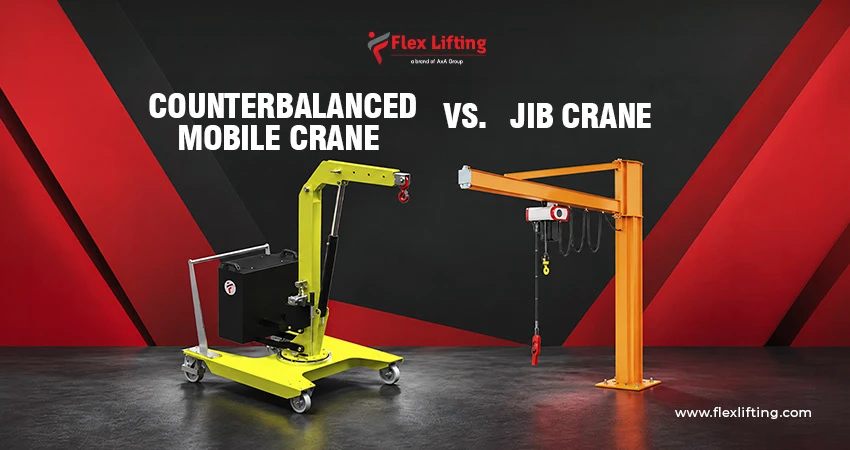
Choosing between a counterbalanced mobile crane and a jib crane depends on how and where the load needs to be lifted.
Both solutions are widely used in industrial environments for lifting, handling and positioning components safely. However, they are designed around two very different concepts.
A jib crane is generally installed permanently in a specific workstation and provides lifting coverage within a defined working radius.
A counterbalanced mobile crane, such as those in the Flex Lifting range, can instead be moved directly to the application and used wherever lifting is required.
Understanding this difference is essential when choosing the most suitable solution for production, maintenance, machine loading and assembly operations.
What Is a Counterbalanced Mobile Crane?
A counterbalanced mobile crane is a floor-based lifting machine that uses counterweights positioned at the rear of the chassis to balance the load lifted at the front.
Unlike fixed lifting equipment, it does not normally require a column to be anchored to the floor, a wall-mounted support or an overhead runway structure.
The crane can be moved directly to the working area and positioned close to the load.
This makes counterbalanced cranes particularly suitable where lifting operations take place at different workstations or where the production layout changes over time.
Flex Lifting counterbalanced cranes are designed to combine:
- mobility;
- compact dimensions;
- horizontal outreach;
- load positioning;
- accessibility around machinery;
- controlled lifting and lowering;
- different manual, semi-electric and fully electric configurations.
Depending on the model and configuration, Flex Lifting cranes can handle loads ranging from approximately 200 kg to 3,000 kg.
One of their main advantages is the possibility of extending the boom beyond the front of the crane.
This allows the hook to reach loads that may be positioned:
- above machines;
- behind barriers or perimeter protections;
- inside machinery;
- over workbenches;
- in areas that are difficult to access with conventional floor-based equipment.
What Is a Jib Crane?
A jib crane consists of a horizontal arm, or jib, mounted on a vertical column or directly onto a suitable wall or structural support.
A hoist moves along the jib, while the arm rotates around its mounting point.
This creates a defined circular or semicircular working area around the crane.
Jib cranes are particularly suitable for lifting operations that are concentrated around a permanent workstation.
Common configurations include:
Column-Mounted Jib Cranes
These cranes are installed on a vertical column fixed to the floor or foundation.
They offer a defined rotation radius and are often used in:
- assembly stations;
- production lines;
- machining areas;
- loading and unloading stations;
- maintenance areas.
Wall-Mounted Jib Cranes
These cranes are fixed to a suitable wall or structural column.
Because they do not require a separate floor-mounted mast, they can help preserve floor space.
However, the supporting structure must be suitable for the loads generated by the crane.
Counterbalanced Mobile Crane vs. Jib Crane: Comparison Table
| Feature | Counterbalanced Mobile Crane | Jib Crane |
|---|---|---|
| Installation | Usually does not require permanent anchoring or a fixed supporting structure | Requires installation on a column, foundation, wall or suitable structural support |
| Mobility | Mobile and transferable between workstations | Fixed to one working area |
| Working Area | Can be moved to different areas of the facility | Limited to the radius of the jib |
| Reach | Boom can extend horizontally toward the load | Reach is determined by the fixed jib length |
| Access Around Obstacles | Can be positioned close to the application and reach beyond obstacles | Access depends on the location of the fixed column and the jib’s operating area |
| Machine Loading | Particularly suitable for reaching toward or inside machinery | Effective when the machine is located within the jib’s fixed working radius |
| Multiple Workstations | One crane can potentially serve several departments or workstations | Normally dedicated to one workstation |
| Production Layout Changes | Easily relocated when the layout changes | May need to be repositioned or reinstalled |
| Floor Space | Requires space for the chassis and counterweights | Column-mounted versions occupy limited floor space; wall-mounted versions can leave the floor almost completely free |
| Structural Requirements | Low compared with a permanently installed lifting system | Requires suitable floor, foundation, wall or supporting structure |
| Overhead Space | No overhead runway required | Requires sufficient clearance for the jib, hoist and suspended load |
| Precision Positioning | Particularly suitable for localized and precise load positioning | Very effective for repetitive lifting inside its fixed working area |
| Repetitive Operations | Suitable, especially when operations occur in different locations | Particularly effective for repetitive lifting at the same workstation |
| Flexibility | High | Lower, because the crane remains in a fixed position |
| Typical Applications | Machine loading, maintenance, mould handling, tooling, assembly, industrial components and changing workstations | Assembly stations, machining areas, welding stations, production lines and repetitive localized lifting |
| Main Advantage | Mobility, outreach and flexible access to the load | Efficient repetitive lifting within a dedicated workstation |
The Main Difference: Mobile Lifting vs. Fixed Workstation
The most important difference between the two solutions is not simply lifting capacity.
It is where the lifting equipment can work.
A jib crane creates a permanent lifting area around a fixed point.
A Flex Lifting counterbalanced crane creates a lifting area wherever the crane is positioned.
This distinction becomes particularly important in modern manufacturing facilities where lifting requirements are not always concentrated at a single workstation.
If one component has to be handled today at a machining centre and another has to be positioned tomorrow in an assembly area, a mobile crane can follow the operation.
A fixed jib crane cannot.
When Does a Jib Crane Make More Sense?
A jib crane is an excellent solution when lifting operations are repetitive and consistently take place in the same location.
For example:
- loading the same machine throughout the production cycle;
- handling parts at a dedicated assembly station;
- lifting components between a workbench and a fixture;
- repetitive loading and unloading within a limited radius.
Because the crane is permanently available at the workstation, the operator can use it whenever required without moving additional equipment into position.
A jib crane can therefore be extremely efficient when the production process is stable and the lifting point remains substantially unchanged.
When Does a Flex Lifting Counterbalanced Crane Make More Sense?
A Flex Lifting crane becomes particularly interesting when the lifting application requires greater freedom of movement.
Multiple Workstations
A mobile crane can serve different machines, departments or production areas.
Instead of installing several fixed jib cranes, one Flex crane may potentially be used for several different lifting operations.
Loads Behind Obstacles
Machine guards, workbenches, barriers or production equipment can prevent lifting equipment from approaching directly beneath the load.
The boom of a Flex Lifting crane can extend toward or beyond these obstacles to position the hook closer to the required lifting point.
Machine Loading
Many machines are not designed around a vertical lifting point directly above them.
A counterbalanced crane can approach the machine from the front and extend its boom toward the component.
This can make it particularly suitable for:
- CNC machine loading;
- mould handling;
- tooling changes;
- maintenance operations;
- assembly of large components.
Changing Production Layouts
Production layouts evolve.
Machines are moved, new production cells are created and existing workstations are reorganized.
A mobile crane can be relocated accordingly.
A fixed jib crane remains tied to the structural point where it was installed.
Applications Where a Column Is Not Practical
Installing a jib crane requires a suitable structural location.
Depending on the installation, this may involve:
- floor anchoring;
- foundation requirements;
- structural verification;
- wall reinforcement;
- sufficient ceiling clearance.
Where these conditions are difficult to meet, a floor-based counterbalanced crane can provide an alternative solution.
Jib Crane or Counterbalanced Mobile Crane: Which Should You Choose?
The choice depends primarily on the nature of the lifting operation.
A jib crane is particularly suitable when:
- the lifting point remains fixed;
- operations are repetitive;
- the same workstation is used continuously;
- the building structure allows permanent installation.
A Flex Lifting counterbalanced crane is particularly suitable when:
- lifting operations take place in different areas;
- the crane must serve several workstations;
- loads need to be reached over or beyond obstacles;
- components need to be positioned close to or inside machinery;
- the production layout changes;
- permanent installation is undesirable or impractical.
In some manufacturing environments, the two solutions can also complement each other.
Fixed jib cranes can handle repetitive lifting at high-frequency workstations, while a mobile Flex crane can be used for maintenance, machine loading and occasional lifting operations throughout the factory.
Fixed Radius or Flexible Reach?
The difference can be summarized very simply.
A jib crane provides lifting capability within a fixed radius.
A Flex Lifting counterbalanced crane provides lifting capability wherever the operation requires it.
For manufacturers that need flexibility, horizontal outreach and precise positioning without installing a dedicated crane at every workstation, a mobile counterbalanced crane can offer a highly adaptable solution.
Move to the load. Reach the lifting point. Position with precision.
Contact Flex Lifting to identify the most suitable crane configuration for your lifting application.