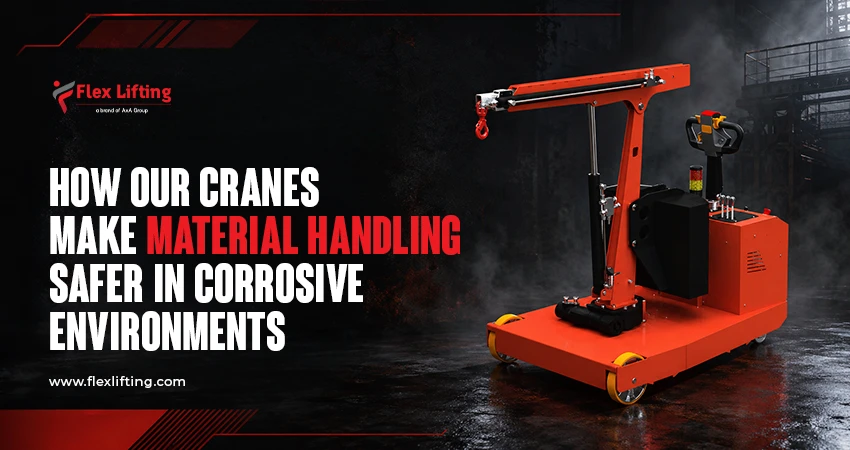
Industrial environments can expose equipment to particularly aggressive conditions on a daily basis. Salt water, chemical vapors, humidity, detergents, and frequent washdowns can gradually compromise the performance and integrity of conventional steel.
For this reason, our stainless steel counterbalanced cranes are designed to operate in environments where corrosion resistance is a fundamental requirement. In this article, we look at why choosing a stainless steel counterbalanced crane can be beneficial and which features make this solution especially suitable for industrial sectors exposed to corrosive conditions.
Why Corrosion Is a More Serious Problem Than It May Seem
Corrosion is not only an issue related to equipment lifespan; it can also become an important safety factor.
Over time, corrosion can weaken metal components, structures, hooks, chains, and other parts involved in lifting operations. Deterioration that is not detected or properly managed can compromise equipment reliability and increase the risk of failure during load handling.
In particularly aggressive environments, the use of materials with greater corrosion resistance therefore helps not only to extend the service life of the crane, but also to preserve its efficiency and reliability over time.
Our stainless steel counterbalanced cranes are specifically designed to cope with these operating conditions, while also helping to reduce maintenance costs and the premature replacement of components damaged by corrosion.
Where Corrosion-Resistant Cranes Make the Difference
Stainless steel counterbalanced cranes are particularly suitable for environments where humidity, water, chemicals, or frequent washdowns are part of normal operating conditions.
Marine and Shipbuilding Industry
Marine environments are characterized by constant exposure to salt water and humidity, two factors that are particularly aggressive toward metals.
In these conditions, a counterbalanced crane made of stainless steel can provide greater resistance than a conventional steel structure, helping to maintain equipment reliability over time.
Food Industry
In food production and processing plants, equipment is often subjected to frequent washing, cleaning, and sanitization procedures.
Stainless steel construction facilitates cleaning operations and offers high resistance to moisture and many of the agents used during hygiene and sanitization processes.
Pharmaceutical and Biomedical Industry
In pharmaceutical and biomedical environments, compliance with high hygiene standards is an essential requirement.
For these applications, stainless steel offers important advantages thanks to its corrosion resistance, ease of cleaning, and suitability for environments where high levels of hygiene must be maintained.
How the 01M5AISI Crane Performs in Corrosive Environments
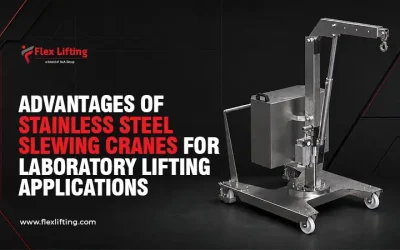
The Flex Lifting 01M5AISI is a counterbalanced crane specifically designed for applications where corrosion resistance is a priority.
Its main features include:
- Stainless steel structure, providing greater corrosion resistance compared with standard painted steel versions.
- Easy-to-clean surfaces, particularly suitable for environments subject to frequent washdowns and sanitization procedures.
- Maximum lifting capacity of up to 500 kg for handling industrial loads and components.
- 360° column rotation, providing high flexibility during lifting and positioning operations.
- Telescopic boom extendable up to 1,270 mm, allowing operators to reach and position loads with greater precision.
- Hydraulic system designed to ensure controlled load handling during lifting and lowering operations.
The combination of these features makes the 01M5AISI a solution designed not only to reduce the effects of surface corrosion, but also to provide reliability and performance in particularly demanding industrial environments.
Why Corrosion Resistance Is Also Important for Safety
Choosing a crane manufactured from corrosion-resistant materials also contributes to the overall safety of material handling operations. Progressive degradation of metal components can reduce the mechanical strength of equipment and increase the need for inspections, maintenance, and component replacement.
Using a stainless steel counterbalanced crane helps limit the effects of aggressive environments on structural components, contributing to more reliable operating conditions over time.
Of course, stainless steel equipment must also undergo the inspections and maintenance procedures specified by the manufacturer. However, selecting materials that are appropriate for the operating environment is an important starting point for improving durability, reliability, and safety.
Conclusion
Not all cranes are designed to operate in environments characterized by high humidity, salt water, chemicals, or frequent washdowns.
Flex Lifting stainless steel counterbalanced cranes are specifically designed for applications where corrosion resistance, ease of cleaning, and long-term reliability are essential requirements.
The 01M5AISI combines the typical advantages of a compact and versatile counterbalanced crane with a construction specifically developed for demanding industrial environments.
Are you looking for a counterbalanced crane designed to operate in corrosive environments? Contact Flex Lifting to identify the configuration best suited to your application.