Even in highly organised manufacturing environments, not every lifting requirement can be predicted.
Urgent maintenance interventions, unexpected component replacements, machine breakdowns, tooling changes and the repositioning of production equipment can create lifting needs that were not included in the original production plan.
When the appropriate lifting equipment is not immediately available, what initially appears to be a minor operational issue can quickly develop into extended downtime, additional labour costs, safety risks and production delays.
In this article, we examine the hidden costs associated with unplanned lifting operations and explain how Flex Lifting counterbalanced mobile cranes can help manufacturing companies respond more efficiently to unexpected material-handling requirements.
The Operational Impact of Unplanned Lifting
The direct cost of an emergency lifting operation is only part of the overall financial impact.
The most significant losses are often generated by the consequences surrounding the lifting requirement: interrupted production, technicians waiting for equipment, delayed maintenance activities, unavailable machinery and the need to reorganise work schedules.
Production Downtime
When a machine, component or production tool cannot be safely lifted or repositioned, maintenance and production activities may come to a complete stop.
The cost of downtime can increase rapidly, especially in automated plants, continuous production environments and facilities operating with tightly scheduled workflows.
A lifting solution that is already available within the facility can help maintenance teams intervene more quickly, reducing the time required to source, transport and install external lifting equipment.
Idle Labour and Overtime Costs
An unexpected production interruption can leave operators, maintenance technicians and contractors unable to continue their work.
Although production has stopped, labour costs continue to accumulate. Additional overtime may also be required to recover lost output and restore the original production schedule.
Reducing the time needed to begin the lifting operation can therefore have a direct impact on overall labour efficiency.
External Equipment Hire
When no suitable lifting device is available on site, companies may need to hire a crane, forklift or specialised lifting service at short notice.
Emergency rental, transport and call-out charges can be significantly higher than planned lifting costs. Availability may also be limited, extending the duration of the production interruption.
Having a compact mobile crane within the facility provides greater operational independence and reduces reliance on external lifting services.
Safety Risks
Unplanned operations can create pressure to complete a lifting task quickly. However, using unsuitable equipment or improvised lifting methods can increase the risk of:
- Unstable Loads
- Dropped Components
- Equipment Damage
- Collisions With Machinery
- Injuries To Operators;
Incorrect Load PositioningThe lifting operation must always be planned according to the load, working radius, available space, floor conditions and rated capacity of the equipment.
A purpose-built counterbalanced crane helps operators manage the load with greater control and precision.
Damage to Machinery and Components
Industrial components are often heavy, delicate and expensive.
Motors, moulds, pumps, machine parts, tools, dies and production equipment can be damaged if they are lifted with inadequate equipment or positioned incorrectly.
Damage may also affect surrounding machinery, conveyor systems, workstations and production infrastructure.
Controlled lifting and accurate load positioning help reduce these risks, particularly during maintenance and installation operations.
Why Counterbalanced Cranes Are Suitable for Unexpected Lifting Requirements
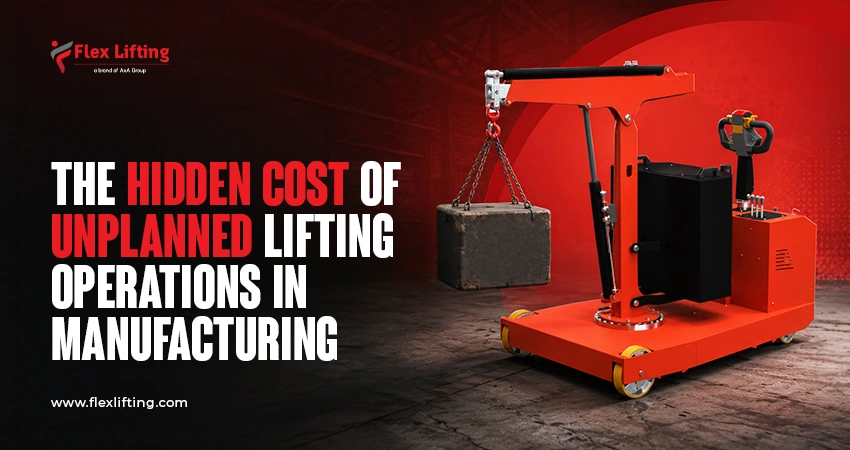
A counterbalanced crane uses ballast positioned at the rear of the machine to balance the load lifted by the boom.
Unlike many conventional lifting devices, the crane does not require front stabilising legs extending beneath the load. This allows the boom to approach machinery, production lines, workbenches and installations with fewer obstructions.
Flex Lifting counterbalanced cranes are designed to provide a practical lifting solution for industrial environments where accessibility, mobility and precise load positioning are essential.
Rapid Deployment
One of the main advantages of a mobile counterbalanced crane is its readiness for use.
The crane can be moved directly to the required work area without the need to install a fixed lifting structure. Depending on the model and configuration, operators can position the machine, connect the appropriate lifting accessory and begin the operation in a relatively short time.
This can be especially valuable during:
- Emergency Maintenance;
- Replacement of Motors and Machine Components;
- Tooling Changes
- Mould Handling
- Installation Of Production Equipment
- Repositioning Of Machinery
- Non-routine Assembly Operations
Faster deployment means maintenance teams can begin working sooner and production can resume more quickly.
Compact Design for Confined Industrial Areas
Manufacturing plants are often crowded with machinery, production lines, storage systems and safety barriers.
Flex Lifting cranes are designed to operate in industrial areas where the available space may be limited. Their compact dimensions allow them to approach the lifting point while minimising interference with nearby equipment.
The counterbalanced configuration also provides a clear frontal working area, making it possible to position the boom over or close to machines, pallets, workstations and production components.
Mobility Between Departments
A mobile crane can serve multiple areas within the same facility.
Instead of installing separate lifting systems in every department, the crane can be transferred between production, maintenance, assembly, warehouse and tooling areas according to operational requirements.
This makes a Flex Lifting crane a versatile shared resource for companies that perform a variety of occasional or unplanned lifting operations.
Depending on the model, Flex Lifting cranes are available with manual or electric traction, allowing the most appropriate solution to be selected according to the load, travel distance and working environment.
Accurate and Controlled Load Positioning
Unexpected lifting operations often require more than simply raising a load.
The component may need to be extracted from a machine, moved around an obstacle, aligned with an installation point or positioned with high accuracy.
Flex Lifting cranes are available with different lifting capacities, boom configurations and control systems. Selected models can be equipped with electric boom extension, radio remote control, electric rotation and proportional movements.
These features allow the operator to control the crane while maintaining a clear view of the load and the surrounding working area.
No Front Outriggers
Traditional cranes and lifting devices may require stabilisers or support structures that occupy the space between the machine and the load.
Flex Lifting counterbalanced cranes do not require front outriggers. The front of the crane can therefore be positioned close to the lifting area, while the boom reaches over machinery, workbenches, pallets or production equipment.
This configuration is particularly useful when lifting components from locations that cannot be easily accessed with a forklift or conventional workshop crane.
Reduced Dependence on Forklifts
Forklifts are essential for transporting palletised goods, but they are not always the most suitable solution for precise lifting close to machinery.
Forks, masts and front dimensions can limit access, while load positioning may be difficult in confined areas or when the lifting point is located above an obstacle.
A counterbalanced crane provides a dedicated lifting boom and hook, offering greater flexibility for suspended loads and maintenance-related operations.
A Flexible Solution for Different Industrial Applications
Flex Lifting offers a wide range of counterbalanced cranes developed for different capacities, working radii and operating requirements.
Applications include:
- Machine Maintenance
- Motor And Pump Replacement
- Mould And Die Handling
- Assembly Operations
- Production-line Maintenance
- Tooling Changes
- Component Installation
- Loading And Unloading Operations
- Positioning Of Industrial Equipment
- Handling Loads In Restricted-access Areas
A wide selection of lifting accessories can also be used according to the load and application, including hooks, lifting beams, clamps, vacuum lifters and customised gripping systems.
Preparedness Reduces the Cost of Downtime
Not every production interruption can be prevented. However, companies can reduce its impact by ensuring that suitable equipment is available when an unexpected lifting requirement occurs.
A Flex Lifting mobile counterbalanced crane can become part of a plant’s maintenance and operational strategy, helping teams respond to unforeseen tasks without immediately relying on external equipment or improvised lifting methods.
Its value is not limited to lifting capacity.
The real advantage is availability: having a compact, mobile and ready-to-use lifting solution exactly where it is needed.
Conclusion
Unplanned lifting operations can generate costs that extend far beyond the lifting task itself.
Production downtime, idle labour, emergency equipment hire, overtime, safety risks and machinery damage can all affect the efficiency and profitability of a manufacturing facility.
Flex Lifting counterbalanced cranes provide a mobile, compact and versatile solution for managing both planned and unexpected lifting operations.
With no front outriggers, multiple configurations and a wide range of lifting capacities, they help maintenance and production teams work more safely, position loads more accurately and reduce the time required to restore normal operations.
Because not every lifting requirement can be planned.
But every manufacturing company can be better prepared.