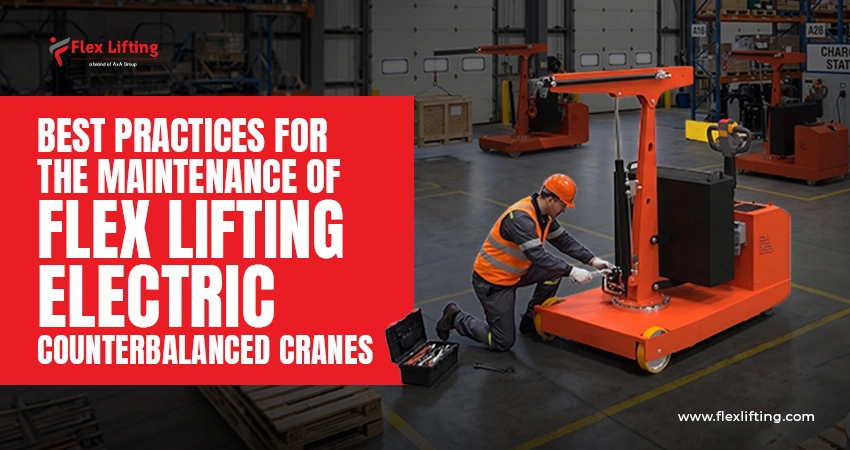
Electric counterbalanced cranes are machines designed to simplify lifting and handling operations inside workshops, warehouses, production departments and industrial environments. However, like any lifting equipment, Flex Lifting cranes also require regular maintenance to ensure safety, efficiency and long service life.
Following the manufacturer’s instructions, periodically checking the hydraulic system, verifying structural integrity and monitoring battery condition are essential activities to ensure the safety, reliability and durability of the machine.
A crane that is not properly maintained may be subject to premature wear, malfunctions or hazardous situations during lifting operations. For this reason, we have collected some good maintenance practices specifically for the Flex Lifting range of electric counterbalanced cranes.
Before moving on to the practical tips, let us first understand what an electric counterbalanced crane is.
What are Flex Lifting electric counterbalanced cranes?
Flex Lifting electric counterbalanced cranes are battery-powered mobile indoor cranes, designed to lift, handle and position loads safely and precisely.
Unlike other lifting solutions that require stabilizers or anchoring points, Flex Lifting cranes use an integrated counterweight system that ensures stability during operations. This allows the operator to work practically even in confined spaces, without having to position stabilizers on the floor.
Thanks to their compact structure, wheeled movement and the different configurations available, Flex Lifting cranes are particularly suitable for:
- Mechanical workshops;
- Production departments;
- Industrial warehouses;
- Assembly lines;
- Machinery maintenance;
- Handling of moulds, mechanical components, engines, equipment and industrial loads.
The Flex Lifting range includes models with different capacities, configurations and control systems, from manual versions to semi-electric and electric cranes with radio remote control, telescopic boom and proportional movements.
Rated capacity depends on outreach
One of the most important aspects to consider when using a counterbalanced crane is that the lifting capacity is not always the same in every boom position.
The maximum capacity indicated for a crane normally refers to a specific configuration, often with the boom in its shortest position. As the boom is extended, the outreach increases and the available lifting capacity decreases.
For this reason, before each lifting operation, it is essential to:
- Know the real weight of the load to be lifted;
- Check the boom position or extension being used;
- Always consult the crane’s load chart;
- Ensure that the capacity indicated for that specific configuration is higher than the weight of the load.
Underestimating this aspect can compromise the stability of the crane and create risks for the operator, the load and the surrounding environment.
Checks before use
Before using a Flex Lifting crane, it is recommended to carry out a general visual inspection of the machine. This simple habit helps identify any anomalies before they can become more serious problems.
The main elements to check are:
Crane structure
Check that the frame, boom and telescopic sections do not show any deformation, cracks, visible damage or loose bolts.
Hook and safety devices
Make sure that the hook is intact, not deformed, and that the safety latch works correctly.
Hydraulic system
Check that there are no oil leaks, damaged hoses or loose fittings. Boom lifting and lowering must take place smoothly and in a controlled way.
Wheels and movement system
Check the condition of the wheels and make sure that the crane moves correctly, without abnormal friction or difficulty in manoeuvring.
Counterweights
Make sure that the counterweights are correctly positioned and secured, according to the specific model.
Battery and electrical system maintenance
In Flex Lifting electric cranes, the battery is a key component to ensure operational continuity, efficiency and reliability.
For correct maintenance of the electrical system, it is important to:
Charge the battery correctly
Always follow the instructions in the manufacturer’s manual. Incorrect or excessively frequent charging can reduce battery life.
Check the terminals
Battery terminals must be clean, properly connected and free from corrosion.
Check cables and connections
Periodically inspect wiring, connections, push buttons, control levers, radio remote control and limit switches to identify any signs of wear, damage or overheating.
Check the battery charger
Make sure that the battery charger is in good condition and is used correctly according to the instructions provided.
Correct battery management helps maintain high crane performance and reduces the risk of machine downtime.
Mechanical and hydraulic maintenance
In addition to the electrical system, mechanical and hydraulic components must also be checked regularly.
Lubrication
Rotation points, moving parts, telescopic sections, pins and other components subject to movement must be lubricated according to the manufacturer’s instructions and with suitable products.
Hydraulic system
It is important to check the hydraulic oil level and the condition of cylinders, hoses and fittings. In case of leaks, irregular movements or abnormal noise, the crane must be checked before continuing use.
Bolt tightening
Vibrations and daily use can cause some fasteners to loosen. Periodic tightening checks help keep the crane safe and efficient.
Boom integrity
The boom is one of the most stressed elements during lifting operations. It is therefore essential to check that it does not show deformation, cracks, signs of impact or abnormal wear.
How important is Crane maintenance
Regular maintenance allows you to:
- Increase the crane’s service life;
- Reduce machine downtime;
- Maintain high performance;
- Improve operator safety;
- Prevent sudden failures;
- Protect the load and the working environment.
A well-maintained crane is more reliable, safer and more efficient over time.
Conclusion
Flex Lifting offers electric counterbalanced cranes that are versatile, compact and ideal for lifting and handling loads in industries .
In order to maintain crane safety, efficiency it’s very important to follow proper maintenance guidelines of the manufacturer.