The invention of the crane helped us erect humongous skyscrapers, making large industrial outdoor work seem like a walk in the park. But as the technology and even the industry shrunk to confined spaces and intense and rigorous work environments where space plays an important role, they needed much more heavy lifting and cross-platform maneuverability for rigorous worksites that operated hand-in-hand adjacent to each other, hence making the invention of mobile cranes one of the most industrial achievements.
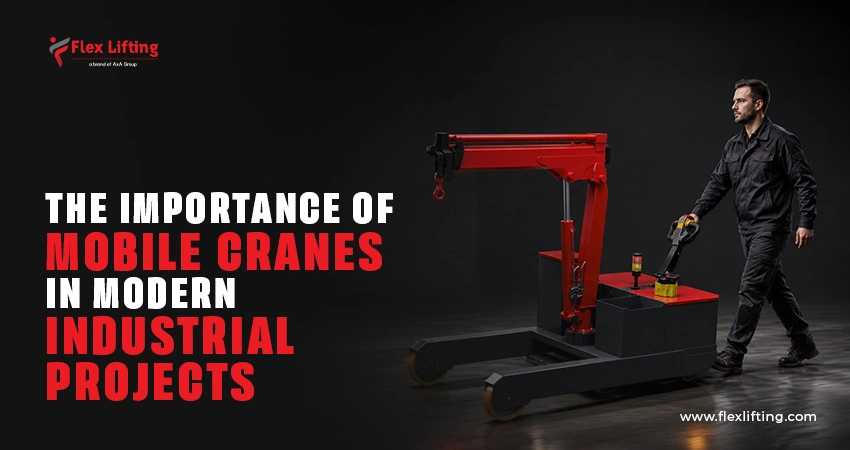
A crane that isn’t stationary; a crane that does not need someone onboard; a crane that looks like a sci-fi movie robot but lifts heavy beams and industrial components like a champ and floats like an agile robotic bee across nearby worksites–that’s what a mobile crane is. Its capabilities are unlimited and so are our industrial possibilities.
In this blog, we will get to know closely about these wondrous modern machines and examine the various advantages they bring to the contemporary industrial terrains where the work is intense, space is limited and maneuverability and efficiency decides everything.
What is a Mobile Crane?
A mobile crane is a champion of confined industrial spaces regardless of whether they are indoor or outdoor, offering cross-platform functionality and efficiency while often being controlled remotely. Contrary to traditional cranes, they are built for maneuvering congested worksites that are high-intensity and injury-prone to humans, making lifting and moving of heavy objects easier and efficient while minimizing downtime and manual work.
- High Portability: These cranes are designed to move easily through rough industrial environments. Their mobility makes them an ideal solution for switching between multiple nearby worksites, allowing operators to begin lifting tasks with minimal setup time. By reducing the need for additional lifting equipment and frequent transportation, a single mobile crane can efficiently serve multiple locations, helping improve productivity while lowering operational costs.
- Compact Design: Modern mobile cranes take very less space than fixed traditional cranes that are fixed for single-site operation. These mobile cranes are experts in cross-platform maneuver and are built to thrive in delivering high-efficiency in congested or adjacent work areas.
- Fast Setup: mobile cranes are simple designs meant to increase efficiency in confined and rough industrial terrains. Unlike traditional cranes, they are ready to deliver in minutes after set up, thanks to their elegant design. The ease of assembling is exactly what makes them the ideal machines for confined, rough and uneven terrains.
Mobile Crane : Uses, Benefits & Overview
1.Equipment Installation
Precise placement of expensive equipment such as heavy machinery, generators, boilers and production equipment is a frequent requirement in industrial spaces. These environments are often spatially limited due to their rigorous and chaotic work nature. Since mobile cranes are meant to tackle this with their sleek design, using them in these terrains can pull in many leverages such as reduced installation time and minimal risk of damage etc.
2. Construction & Structural Assembly
Manual cranes are weight lifting megatrons–there’s no doubt. But when you have to lift steel beams, concrete panels and other structural components and move and place them precisely in confined regions, mobile cranes make all the difference as their superior maneuvering ability makes the lifting and placing of these heavy objects easier while allowing workers to safely assemble them at height.
3. Plant Maintenance
Imagine plant maintenance– a task that involves lifting and moving heavy motor parts,pumps, molds and other machine parts–and doing all the work manually… it’s gonna be extremely hard on the personnel and your schedule as well. Mobile cranes, on the other hand, were built for such tasks. With their elegant design and sleek movement–often remote-controlled–they will ensure timely completion of tasks while cutting down on downtime, manual labour and help resume operations quicker.
3. Material Handling
In space-constrained worksites, moving of materials between areas is a challenge in itself. Without easy maneuvering options, the overall workflow lags behind, especially when the manual labour here is limited, slow and injury-prone. The mobile crane tackles this problem by design. They can wander across multiple locations simultaneously lifting and moving heavy objects while being controlled remotely with minimal manual operation.
5. Loading & Unloading Operations
They deliver exceptional efficiency in handling oversized cargo from trucks, trailers, railcars or shipping containers. By reducing manual work, they can manage all the lifting and moving of goods safer and faster without causing any damage to valuable materials.
6. Renewable Energy Projects
They are indispensable in the energy sector as well. They can be comprehensive lifting and moving solutions in the installation of wind turbine sections, generators and energy infrastructure components without involving manual labour. This ensures the lifting height and capacity needed for large-scale energy projects.
7. Warehouse & Logistics Support
They serve the same in warehouses and logistics operations as well. They are really dependable in relocating heavy inventory, machinery, and industrial equipment, which in turn improves operational flexibility and allows facilities to adapt quickly to varying requirements.
8. Infrastructure Development
Their ability to conquer uneven surfaces make them an ideal tool in infrastructure development as well. From bridge construction, pipeline installations, utility network expansion to transportation developments, they can easily handle and maneuver while lifting heavy structural components, concrete sections, steel girders, pipes and other utility equipment with unmatched precision. Their ability to travel across uneven terrain and operate in challenging outdoor environments gives project teams the flexibility to perform lifting operations where fixed cranes may not be practical. This mobility and lifting capability help keep infrastructure projects on schedule, improve worker safety, and ensure reliable performance.
Mobile Cranes : Key Uses
Keep in mind–mobile cranes are called mobile for a reason. They thrive in confined spaces, whether indoor or outdoor, on terrain surfaces that are uneven, require inter-platform mobility and heavily relies on the lifting and transportation of heavy materials or components between one another. Here are some of its best benefits so you have a concise understanding of what you just read.
- High mobility between work areas
- Faster setup compared to fixed cranes
- Reduced project completion times
- Improved workplace safety
- Lower manual labor requirements
- Precise load positioning
- Ability to operate in confined spaces
- Cost-effective lifting solution
- Versatile across multiple industries
- Reduced equipment transportation costs
- Increased productivity and operational efficiency
- Suitable for both indoor and outdoor applications
Conclusion
Mobile cranes are ideal for heavy lifting and precision-placement across diverse industries . Compared to traditional cranes, these mobile cranes are smaller machines perfect for confined and rigorous worksites where space is limited. Mobile cranes uses compact lifting, moving and placing of heavy materials solution by design, enabling cross-platform maneuverability while avoiding downtime and manual labour.