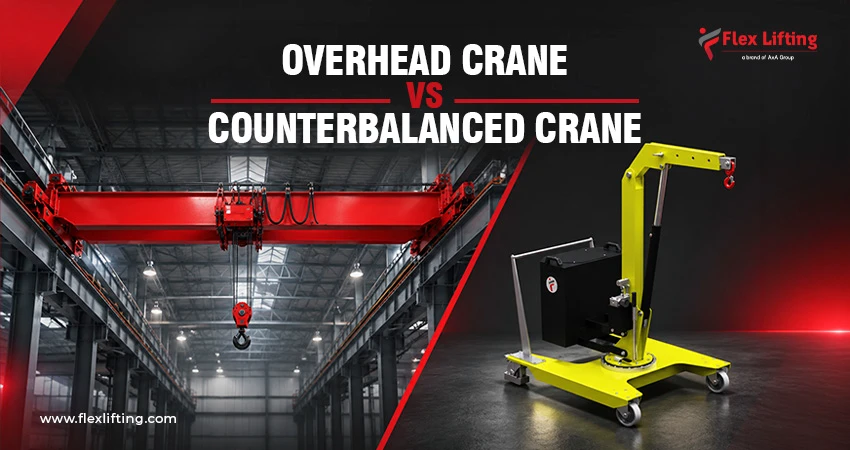
Choosing the right lifting solution is not simply a question of lifting capacity. In industrial environments, factors such as available space, accessibility, outreach, installation requirements, production layout and the need to position loads precisely can be just as important. Two very different solutions are commonly considered for handling heavy components: traditional overhead cranes and mobile counterbalanced cranes such as the Flex Lifting range.
Both are designed to lift and position loads safely, but they solve very different handling problems.
What Is an Overhead Crane?
An overhead crane is a permanently installed lifting system typically used inside production plants, warehouses and industrial facilities.
A bridge or gantry structure allows a hoist and hook to move above a predefined working area, enabling operators to lift and transfer heavy loads vertically and horizontally.
Overhead cranes are particularly effective when:
- loads are repeatedly handled within the same area;
- high lifting capacities are required;
- the production layout is permanent;
- large floor areas need to remain unobstructed;
- loads can be approached directly from above.
Once installed, an overhead crane can provide excellent coverage of a dedicated production area.
However, installation normally requires runways, supporting structures, engineering checks and sufficient overhead space. This means that implementing or modifying an overhead crane system can become complex when the production layout changes.
What Is a Counterbalanced Crane?
Counterbalanced cranes are mobile industrial lifting machines designed to lift, reach and precisely position loads without requiring a permanently installed overhead structure.
Instead of bringing the load underneath a fixed crane system, the operator can bring the crane directly to the work area.
Depending on the model and configuration, Flex Lifting cranes can handle loads from approximately 200 kg up to 3,000 kg and are available in manual, semi-electric and fully electric versions.
Their counterbalanced architecture allows the boom to extend in front of the machine without the front forks typically associated with traditional material-handling equipment.
This makes them particularly suitable for applications where operators need to:
- reach over machines or production equipment;
- pick up loads from difficult positions;
- position components inside machinery;
- handle loads behind obstacles;
- work in narrow production areas;
- move the same lifting equipment between different departments or workstations.
Overhead Crane vs. Counterbalanced Crane: Comparison Table
| Feature | Overhead Crane | Counterbalanced Crane |
|---|---|---|
| Installation | Requires permanent installation, runway beams or supporting structure | No permanent overhead installation required |
| Mobility | Fixed to a predefined working area | Mobile and transferable between workstations |
| Working Area | Limited to the area covered by the crane runway | Can be moved directly to different production areas |
| Building Modifications | May require structural modifications and engineering assessment | Normally does not require structural modifications to the building |
| Overhead Space | Requires sufficient ceiling height for bridge, trolley and hoist | Suitable for many applications where overhead space is limited |
| Load Access | Mainly approaches the load vertically from above | Can approach the load from the front and extend toward it |
| Outreach | Determined by bridge and trolley position | Telescopic boom allows horizontal outreach |
| Reaching Over Obstacles | Limited when machinery or structures obstruct the hook path | Designed to reach over benches, barriers, machines and production equipment |
| Machine Loading | Effective when the load can be positioned directly underneath the hook | Particularly suitable for positioning loads inside or close to machinery |
| Precision Positioning | Excellent within the crane’s predefined working area | Excellent for localized lifting, reaching and positioning operations |
| Layout Flexibility | Low — infrastructure is permanently installed | High — crane can follow changes in production layout |
| Multiple Workstations | Additional runway coverage or cranes may be required | One mobile crane can potentially serve several workstations |
| Floor Space | Keeps most floor area clear | Requires space for the mobile chassis and counterweights |
| Infrastructure Dependency | High | Low |
| Typical Applications | Repetitive lifting in production lines, warehouses and assembly areas | Machine loading, maintenance, assembly, mould handling, tooling and difficult-to-access loads |
| Best Advantage | Large fixed-area coverage and high repetitive lifting capacity |
The Main Difference: Fixed Coverage vs. Flexible Access
The fundamental difference between the two systems is how they reach the load.
With an overhead crane, the lifting system is permanently installed and the load must remain within the crane’s operating area.
With a Flex Lifting counterbalanced crane, the lifting equipment can be moved directly to the load.
This difference becomes particularly important in production environments where lifting points change frequently or where machines, benches and other equipment prevent direct vertical access.
A Flex crane can be positioned close to the application and its boom extended toward the load, providing the operator with the ability to lift, reach and position from a compact mobile platform.
The Main Difference: Fixed Coverage vs. Flexible Access
The fundamental difference between the two systems is how they reach the load.
With an overhead crane, the lifting system is permanently installed and the load must remain within the crane’s operating area.
With a Flex Lifting counterbalanced crane, the lifting equipment can be moved directly to the load.
This difference becomes particularly important in production environments where lifting points change frequently or where machines, benches and other equipment prevent direct vertical access.
A Flex crane can be positioned close to the application and its boom extended toward the load, providing the operator with the ability to lift, reach and position from a compact mobile platform.
When Does an Overhead Crane Make More Sense?
An overhead crane is particularly suitable when the same production area needs to handle heavy loads continuously throughout the day.
Typical applications include:
- large manufacturing plants;
- steel processing;
- warehouses;
- repetitive assembly operations;
- production areas requiring continuous overhead coverage;
- applications involving very high lifting capacities.
For these situations, a permanently installed crane can provide excellent productivity.
When Does a Flex Lifting Crane Make More Sense?
A Flex Lifting counterbalanced crane becomes especially interesting when flexibility and accessibility are more important than covering an entire building.
Typical scenarios include:
Loads Behind Obstacles
Machines, workbenches, barriers or production equipment may prevent conventional lifting equipment from approaching the load.
The telescopic boom of a Flex crane can reach beyond these obstacles and position the hook where it is needed.
Machine Loading and Maintenance
Components may need to be removed from or installed inside machinery.
Because the boom can extend beyond the crane chassis, Flex cranes can position loads close to or inside the machine without requiring the lifting equipment itself to occupy the same space.
Multiple Workstations
A permanently installed overhead crane is dedicated to a specific area.
A mobile Flex crane can instead be transferred between production departments, allowing the same lifting equipment to serve different applications.
Changing Production Layouts
Factories evolve.
Machines are relocated, production lines change and new workstations are added.
A mobile crane can adapt to these changes without requiring a complete redesign of overhead lifting infrastructure.
Limited Overhead Space
In buildings with low ceilings or structural limitations, installing an overhead crane may not always be practical.
A compact floor-based counterbalanced crane can provide an alternative lifting solution without requiring overhead runways.
Overhead Crane or Flex Lifting Crane: Which Should You Choose?
There is no universal answer because the two systems address different lifting requirements.
If your application involves continuous heavy lifting within a permanent production area, an overhead crane may be the most appropriate solution.
If instead you need to move the lifting equipment between different areas, reach over obstacles, access machinery or position loads where traditional lifting equipment struggles to reach, a Flex Lifting counterbalanced crane can provide a much more flexible approach.
In many factories, the two technologies can also complement one another.
An overhead crane can manage general material movement across a large production area, while a mobile Flex crane can handle localized operations requiring greater accessibility and precise positioning.
A Different Approach to Industrial Lifting
Traditional overhead cranes bring the hook to the load from above.
Flex Lifting brings the entire lifting solution directly to the operation.
This makes it possible to combine lifting capacity with mobility, horizontal outreach and precise positioning — without permanently modifying the production facility.
For manufacturers looking for a flexible solution for machine loading, maintenance, component assembly or difficult-to-access loads, Flex Lifting counterbalanced cranes offer an alternative approach to conventional fixed lifting systems.
Lift. Reach. Position. Without fixed infrastructure.
Contact Flex Lifting to identify the most suitable configuration for your application.