People think that industrial lifting and cranes are only about the weight they can manage. As if the weight capacity is the most important thing—500 kg, one tonne, two tonnes. How far can it reach? How compact is it?
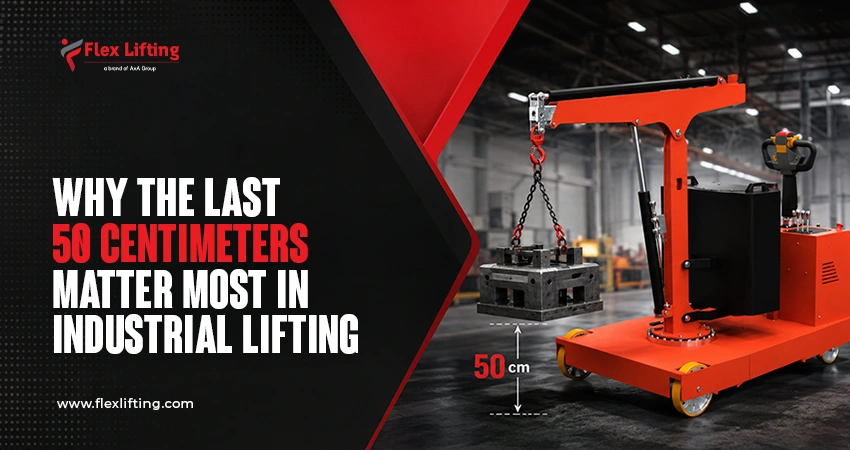
Experts in this field know what actually matters in industrial lifting—it isn’t just the lifting alone, or the distance it can reach. It’s the last 50 centimetres before the load reaches its final position. From installing machinery, loading a CNC machine, and placing a pressure vessel to lowering a steel beam onto its supports, it all heavily depends on precise positioning.
A slight swing or misalignment can lead to irreversible equipment damages, project delays and sometimes even injuries to the workers.
It Doesn’t End with Lifting
The lift begins with simple objectives: raise it smoothly and place it elegantly in the predetermined position. Here, maintaining stability, avoiding obstacles and keeping the load balanced are paid the most attention, and at this stage, the load is simply being transported.
The challenging part is when the load has to be lowered into place with pinpoint accuracy, and precise positioning of it attains key importance.
Why the Final 50 Centimeters Require Precision
When the load approaches the final stage and gets to the landing point, there is no room for error anymore. The load alignment must be done thoroughly by the operator with some final adjustments before it is actually lowered towards the landing destination. The operator often is guided by the cooperative efforts of the workers as well, which proves that the communication across the workforce is really important.
This is not something dependent on lifting power alone; more than weight capacity, it requires smooth movement, excellent control and equipment that works exactly as the operator requires.
Accurate Positioning—a Regular Industrial Requirement
If you generally look into other industries that heavily rely on heavy lifting, you can understand most of them prioritise precise placement over general heavy lifting.
This is highly prioritised in many industrial applications, including positioning of heavy machinery, installation of generators, lifting and lowering of steel beams, placement of concrete barriers, pressure vessel installation and loading CNC machines.
Here, lifting is important, but only in its precise placement and control. Finishing the task without unnecessary movements is the key.
Hazards Associated
The placement stage of the lift is prone to many risks by design. Common hazards in this process include pinch points, crush injuries, swinging loads, improper use of tag lines, miscommunication, limited landing area visibility, sudden load shifts, uneven landing and finger injuries. These risks are increased when the lifting equipment does not have the necessary control to ensure accurate positioning.
How Our Counterbalanced Cranes Make a Difference
Weights are handled by forklifts and other traditional lifting systems. They are, in fact, ideal systems dedicated to this when it comes to lifting and transporting heavy loads. But how reliable will they be when accurate, millimetre-level precision is required? How can they handle that precision with that weight without the risk of swing or injury?
The answer is counterbalanced cranes. They help operators to move loads smoothly, eliminate unwanted swinging, and make precise adjustments during the final positioning stage. Better control not only means increased efficiency; it also means elevated security for everyone across the jobsite.
Conclusion
For every lift to be carried out efficiently, it requires reliable equipment, qualified operators and clear communication between the staff on the ground. Having status-quo lifting capacity doesn’t alone ensure seamless, accurate positioning. What truly matters is how confidently the load can be placed exactly where it needs to go.
Flex Lifting sees industrial lifting not just as managing heavy loads. Weight capacity is only as good as the precision it maintains in landing it accurately. It’s about delivering the control, stability, and precision operators need during the most critical stage of every lift—the last 50 centimetres. Flex Lifting’s counterbalanced cranes give operators smooth, controlled, millimetre-precise positioning—even in tight spaces where accuracy matters most.