Industrial lifting has changed significantly over the years. Traditional overhead cranes and fixed lifting systems still play an important role in many production environments, but modern factories, workshops and logistics areas often require something more flexible: a compact lifting solution that can move where the work actually happens.
This is where mobile lifting cranes make the difference.
Designed to support lifting, positioning and handling operations in different areas of the same facility, mobile cranes offer a practical alternative to fixed systems, especially when companies need flexibility, precision and safety in confined or constantly changing workspaces.
As a European manufacturer of industrial lifting solutions, Flex Lifting develops a wide range of mobile cranes designed for companies that need to lift and move loads efficiently inside production departments, maintenance areas, warehouses and assembly lines.
Flex Lifting Mobile Cranes: Compact Solutions for Industrial Lifting
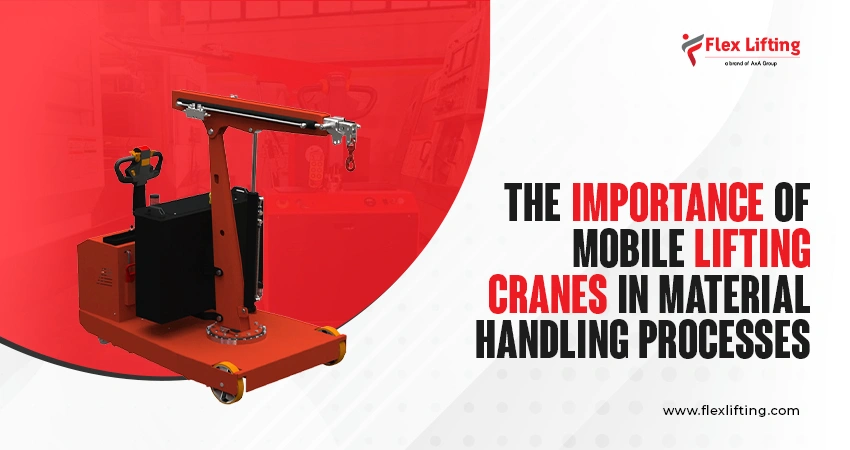
The Flex Lifting range includes different types of compact mobile cranes, designed to meet a variety of material handling requirements.
Depending on the model and configuration, Flex Lifting cranes can offer:
- lifting capacities suitable for light, medium and heavy-duty applications;
- compact dimensions for use in narrow or crowded workspaces;
- manual, semi-electric or fully electric functions;
- fixed or rotating arms depending on the application;
- telescopic booms for greater working reach;
- ergonomic controls for precise load handling;
- battery-powered operation for indoor industrial use;
- safety systems designed to support controlled and reliable lifting.
This variety allows companies to choose the most suitable crane according to the load, available space, working height, required outreach and type of operation.
Whether the need is to lift machine components, moulds, tools, batteries, metal parts, equipment or production materials, Flex Lifting mobile cranes are designed to make internal handling safer, easier and more efficient.
Why Mobile Lifting Cranes Are Important in Industrial Applications
Mobility Where It Matters
One of the main advantages of mobile lifting cranes is their ability to move directly to the work area.
Unlike fixed lifting systems, which are limited to a specific zone, mobile cranes can be used in different departments, production lines or maintenance areas. This makes them especially useful in companies where lifting operations are not always performed in the same place.
In modern industrial environments, flexibility is essential. A mobile crane can support different teams, different processes and different workstations without requiring permanent installations or complex structural modifications.
This helps reduce waiting times, improve workflow and make lifting operations more independent.
Flexibility Across Departments
Many companies need to move loads between production, assembly, testing, maintenance and storage areas. In these situations, a fixed crane may not be enough.
Flex Lifting mobile cranes are designed to support cross-department operations, helping operators lift and position loads in different areas of the facility. Their compact design and manoeuvrability make them particularly useful in industrial spaces where forklifts, bridge cranes or larger lifting systems may not be practical.
This flexibility is important for companies that handle different types of loads or need a lifting solution that can adapt to changing production needs.
Precision in Load Positioning
Material handling is not only about lifting a load. In many industrial applications, the real challenge is positioning it correctly.
Flex Lifting cranes are designed to help operators handle loads with greater control and accuracy. Depending on the model, features such as telescopic booms, rotating arms, proportional controls, electric movements or controlled lowering systems can support precise positioning during assembly, maintenance or installation tasks.
This is particularly valuable when handling delicate, heavy or expensive components, where uncontrolled movements can cause damage, delays or safety risks.
Compact Design for Confined Spaces
Space is one of the biggest challenges in many production environments. Machines, workbenches, storage areas and operators often share the same floor space, leaving little room for large lifting equipment.
Mobile lifting cranes are built to work in these conditions.
Thanks to their compact footprint, Flex Lifting cranes can be used in narrow aisles, crowded departments and areas with limited access. This makes them a practical solution for workshops, manufacturing plants, maintenance departments and industrial facilities where every square metre matters.
Reduced Setup Time
Traditional lifting systems often require installation, structural checks or dedicated operating areas. Mobile cranes, on the other hand, are designed to be ready for use with minimal setup.
This can be a major advantage for companies that need to perform lifting operations quickly and efficiently.
A mobile crane can be brought close to the load, used for the operation and then moved to another area when needed. This makes it ideal for maintenance work, occasional lifting tasks, production support and applications where flexibility is more important than permanent infrastructure.
Improved Safety and Ergonomics
Manual handling of heavy or awkward loads can increase the risk of injuries, accidents and damage to materials.
Mobile cranes help reduce these risks by giving operators a controlled lifting aid for tasks that would otherwise require excessive physical effort or unsafe handling methods.
Flex Lifting cranes are developed with attention to safety, stability and ease of use. Depending on the model, they can include safety hooks, braking systems, overload protection, battery status indicators, acoustic or visual alarms and other devices designed to support safe operation.
By improving ergonomics and reducing manual strain, mobile cranes can contribute to a safer and more efficient workplace.
Where Flex Lifting Mobile Cranes Can Be Used
Flex Lifting mobile cranes can be used in many industrial sectors, including:
- manufacturing plants;
- mechanical workshops;
- maintenance departments;
- automotive and aerospace industries;
- logistics and warehousing;
- mould and tool handling;
- machinery assembly;
- battery handling;
- metalworking and fabrication;
- industrial repair and installation activities.
Their versatility makes them suitable for both regular production tasks and occasional lifting operations where a fixed system would be too expensive, too large or not flexible enough.
A Smart Alternative to Fixed Lifting Systems
Mobile lifting cranes are not always intended to replace overhead cranes or fixed lifting systems. In many cases, they complete them.
A company may already have bridge cranes or forklifts, but still face lifting challenges in areas that those systems cannot reach. In these cases, a compact mobile crane can fill the gap, offering a practical solution for localised lifting operations, precise positioning and internal material handling.
This makes Flex Lifting cranes a strategic investment for companies looking to improve productivity without changing their entire plant layout.
Conclusion
Mobile lifting cranes have become an essential tool for modern material handling. Their combination of mobility, compact design, precision and safety makes them ideal for industrial environments where flexibility is key.
For companies that need to lift, move and position loads in different areas of the facility, Flex Lifting offers a complete range of mobile crane solutions designed to support efficient, safe and practical operations.
When precision, manoeuvrability and reliability matter, Flex Lifting delivers mobile lifting solutions built for the needs of modern industry.